Rebuilders rise: Gamified approach to early intervention for compulsive hoarding behaviour

Rebuilders rise: Gamified approach to early intervention for compulsive hoarding behaviour

Behavioral design - Game design

My role

Ideation, motion design, wireframing

Project type

Behavioral Game design

Team

2 designers

My role

Ideation, motion design, wireframing

Duration

1 month

What are we solving for

What are we solving for

Current Behaviour

People tend to hold on to objects for long periods of time even when those items are no longer useful or needed. They struggle to discard possessions due to emotional attachment, fear of future need, or fear of losing memories associated with those objects.

Desired Behaviour

To encourage a healthier relationship with possessions, where individuals are able to evaluate what they truly need and feel emotionally comfortable letting go of unnecessary items, without guilt, fear, or distress.

Current Behaviour

People tend to hold on to objects for long periods of time even when those items are no longer useful or needed. They struggle to discard possessions due to emotional attachment, fear of future need, or fear of losing memories associated with those objects.

Desired Behaviour

To encourage a healthier relationship with possessions, where individuals are able to evaluate what they truly need and feel emotionally comfortable letting go of unnecessary items, without guilt, fear, or distress.

Research Data viz.

Research Data viz.

Why Focus on Young People?

Why Focus on Young People?

Hoarding doesn’t suddenly appear in old age. It can start much earlier, during the teenage years and early adulthood, when people begin developing strong habits around keeping and holding onto things.

Small behaviours like “I might need this someday,” feeling emotionally attached to objects, or finding it hard to throw things away can gradually build over time. Focusing on young people gives us a chance to understand and address these behaviours before they become deeply rooted.

Hoarding doesn’t suddenly appear in old age. It can start much earlier, during the teenage years and early adulthood, when people begin developing strong habits around keeping and holding onto things.

Small behaviours like “I might need this someday,” feeling emotionally attached to objects, or finding it hard to throw things away can gradually build over time. Focusing on young people gives us a chance to understand and address these behaviours before they become deeply rooted.

Final solution :

Final solution :

THE REBUILDERS RISE is a strategy game where players have to rebuild a fallen empire back to its glory. To do this the player has 5 structures (Library, government hall, market, defence and Bank) use the resource cards the player gets at the start of the game . The player travel from the side to the centre of the board(the city heart). To win they have to build these structures and also collect 5 Trade token (by trading cards with another players) and 10 Charity tokens (by giving resource cards in charity). The one who builds this structures, collects these tokens and reaches the center first is the emperor (wins the game) There are 2 main aspects to the game . The core mechanics that target different aspects of behaviour. Second, the gamification that adds on the fun and competitiveness of the game. The core game aspects like charity and trade tokens targets the decision making and encouraging the ‘art of letting go’ . As they need to decide what items they need and don't need. The structures that they need to build focuses on allocation of resources and organizing items neatly. The path they have to follow promotes and step by step and time bound approach to discarding and organizing.

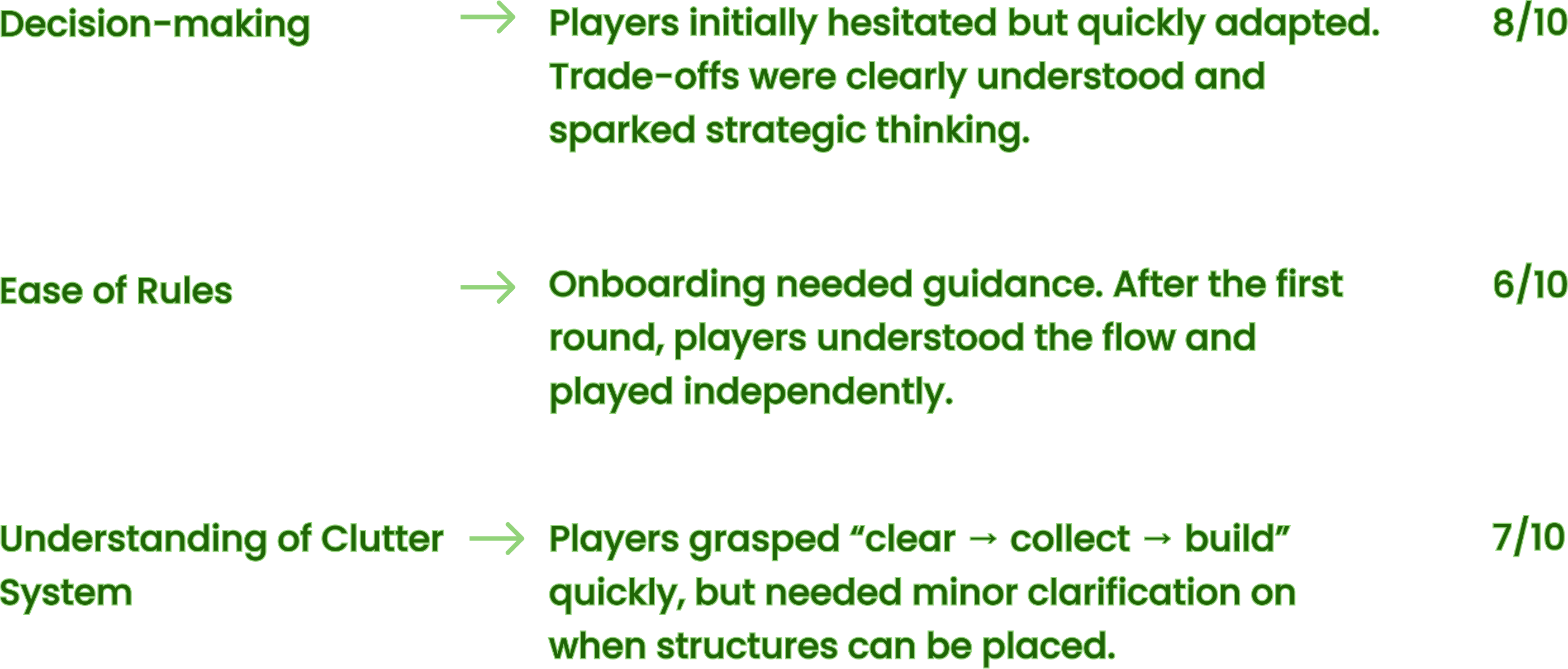
User testing results :

User testing results :

Create a free website with Framer, the website builder loved by startups, designers and agencies.